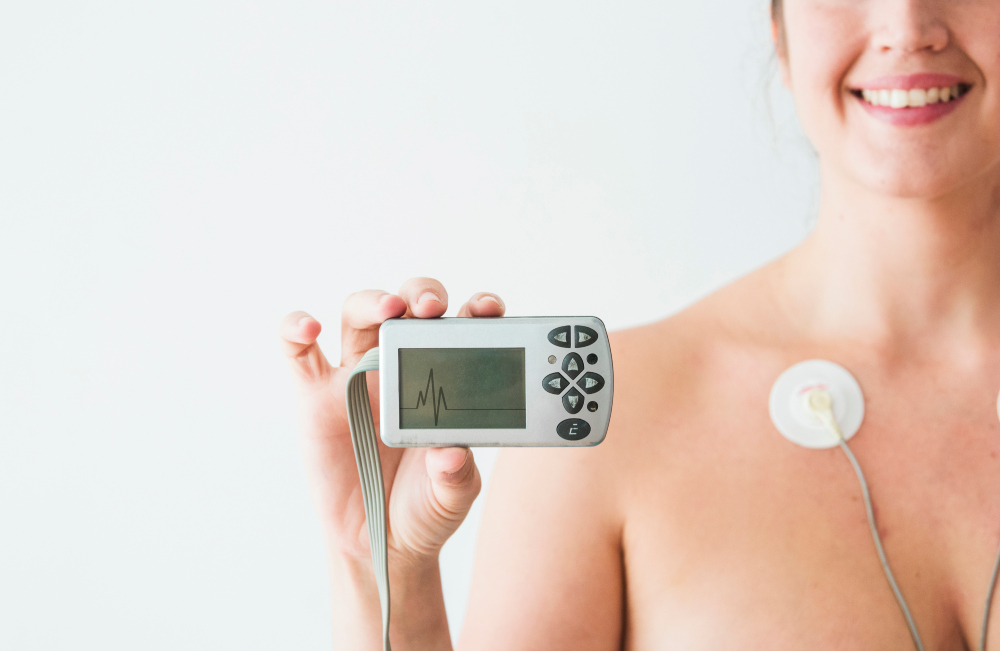

Holter monitors and implantable loop recorders are tiny recording devices that examine your heart’s electrical activity for signs of an irregular or abnormal heart rhythm, such as atrial fibrillation, bradycardia (a slow heart rate) or tachycardia (fast heart rate).
Both devices are very useful for capturing symptoms and events that might not have been picked up by other kinds of tests, such as an electrocardiogram (ECG). This means they can help us get to the root of your symptoms and what might be causing them. But they also differ in some important ways. In this article, we’ll explore how they differ – and why you might need one device or the other.
What’s the Difference Between a Holter Monitor and Implantable Loop Recorder?
The main difference between a Holter monitor and an implantable loop recorder is in how you wear the device and how long for:
Holter monitor – this is an external device that you carry around with you; it’s connected by wires to some electrode patches on your chest. You would usually wear it for 24-48 hours, though potentially for up to a week (or in rarer cases a month)
Implantable loop recorder (ICR) – this is an internal device that’s inserted under the skin of your chest. It monitors and records electrical activity in your heart over a much longer period, anywhere from a few months to three years.
So how exactly do they work? Let’s look at both devices in a bit more detail…
What Is a Holter Monitor?
Holter monitors have been around since the 1960s – they take their name from Norman Holter, the American biophysicist who invented them. Like ECGs, Holter monitors collect data about your heart’s electrical activity to see if you have an irregular heart rhythm.
Unlike an ECG, you don’t have to take the test in a clinical setting. After coming into the hospital or clinic for the initial fitting, you’ll take the device home with you. The technician or cardiologist will place some sticky electrode patches on your chest, then connect them to your device. It’s about the size of a pack of cards and sits in a pouch over your shoulder or on your belt. The idea of the test is to see what’s happening in your heart over the next few hours and days, as you go about your normal everyday routines.
The Holter monitor will record continuously, capturing all the activity that’s happening in your heart. When the test is over, we’ll download the data and analyse it to see if there are any irregularities in your heart rhythm.
What Is an Implantable Loop Recorder?
Implantable Loop Recorders (ILRs) are tiny devices that are placed subdermally (underneath the skin). You might also hear them called Implantable Cardiac Monitors (ICMs). Loop recorders are even smaller than Holter monitors – about 7mm wide by 4mm deep, and roughly the length of a matchstick.
Like Holter monitors, they are designed to record and store data about your heart’s electrical activity, not to provide any treatment for it (that’s the role of devices like pacemakers and internal defibrillators). But loop recorders capture data over a much longer period than Holter monitors – anything up to three years, depending on your situation. They also record on a constant loop (hence the name), transmitting data wirelessly to your clinic and then overwriting older data.
A useful comparison is a movie camera versus a security camera. A Holter monitor works like a movie camera, recording continuously. An implantable loop recorder is more like a security camera, overwriting older footage until an important event occurs. Loop recorders also come with a hand-held key fob device called a symptom activator. This allows you to ‘bookmark’ any concerning episodes – like sudden dizziness, skipped beats or feeling faint – by holding the fob close to your chest and pressing a button to connect it to the recorder.
When Is Each Test Recommended?
So… Holter monitor or implantable loop recorder? This is a choice your cardiologist will make based on your own particular situations and symptoms. How do they decide to use one over the other?
When Doctors Choose a Holter Monitor
It really comes down to frequency… If your symptoms are intermittent but occur at least once every day or every other day, a Holter monitor is a good choice. It will capture the irregular rhythm when it occurs, and the cardiologist will see that anomaly clearly when they analyse your data. This is why we’ll often ask you to keep a symptom journal during the testing period; it helps us match your symptoms to the irregular rhythm. So Holter monitors are used for frequent, short-term monitoring.
When Doctors Recommend a Loop Recorder
If your symptoms are happening very infrequently – perhaps once every few months – a loop recorder may be the better option. It stays with you for the long term, so it can capture rarer events that just wouldn’t be picked up by other heart tests.
It has some other useful applications too, such as keeping watch over your heart’s electrical activity after you’ve had a heart attack or stroke, or long-term monitoring of an arrhythmia that has already been diagnosed.
Cardiologists sometimes also use loop recorders if you’ve had a type of surgical treatment called a cardiac ablation, to see whether the procedure has worked or if the irregular rhythm is still present.
Pros and Cons of Each
There are some other things to bear in mind when comparing these devices. A Holter monitor is slightly less convenient in the short term. You have to carry it around with you and make sure everything stays connected; and, although you can take the more modern devices into a shower, you normally wouldn’t be able to go for a swim with one. But, once the test is over, you simply hand it back and wait for the results.
A loop recorder is more discreet and won’t require any external care while the test is ongoing. But, on the other hand, you need surgery for the implantation and removal, and you’ll be living with the device for a much longer period. The implantation / removal is a minor procedure that only takes 10-15 minutes to complete and can be done with a local anaesthetic. But it’s worth factoring this in when you’re considering the options.
Here’s a quick comparison to summarise the differences.
| Feature | Holter Monitor | Loop Recorder |
| Duration | 24–48 hours | Up to 3 years |
| Invasiveness | Non-invasive | Minor surgical procedure |
Best for | Frequent symptoms | Rare/unexplained symptoms |
Data recording | Continuous | Intermittent or triggered |
| Cost | Lower | Higher |
Which One Is Right for You?
So, as a general rule of thumb, a Holter monitor is an effective test if your symptoms are happening quite frequently (but not so frequently that an ECG will pick them up). An implantable loop recorder is a better option if your symptoms are unexplained or happening very infrequently.
But choosing the right type of test isn’t something you have to do on your own – we’ll assess your symptoms, talk you through the options, and recommend the best device for your own situation.
Diagnosing Heart Rhythm Problems with Heart Rhythm Cardiologist
Are you worried about your heart, or getting some new or unexplained symptoms that you’d like to investigate? We’re here to help. Heart Rhythm Cardiologist is one of Ireland’s leading specialists in heart rhythm disorders, with everything you need for a swift diagnosis and ongoing treatment and care.
It’s quick and easy to book an appointment with Dr Lyne and the team – just jump to our contact page for all the details.
We hold clinics every Tuesday and Thursday at the Blackrock Clinic in Dublin, and additional surgical appointments at the Beacon Hospital, Hermitage Medical Clinic and St Vincent’s Private Hospital. Whatever you need, we’re here to support you.
Common Questions About Holter Monitors and Implantable Loop Recorders
Both devices are used to record your heart’s electrical activity over an extended period of time in order to detect irregular rhythms that a standard electrocardiogram (ECG) might miss.
A Holter monitor is an external device worn on a belt or over the shoulder with wires connected to your chest, while a loop recorder is a tiny device inserted under the skin.
Holter monitors are usually worn for 24 to 48 hours, whereas implantable loop recorders can monitor your heart for anywhere from a few months up to three years.
A Holter monitor records continuously like a movie camera, while a loop recorder acts more like a security camera, overwriting old data until a specific cardiac event occurs.
When you come in for your fitting, the team will give you a symptom activator to take home with you. This is a little hand-held key fob that enables you to add a “bookmark” to the recording whenever you experience a symptom like dizziness or palpitations.
The choice usually comes down to the frequency of your symptoms. A Holter monitor is best for symptoms that happen once every day or so, while a loop recorder is ideal for infrequent symptoms that may only happen every few months.
No, it’s a minor 10-to-15-minute procedure performed under local anaesthetic to place the matchstick-sized device just beneath the skin of your chest.